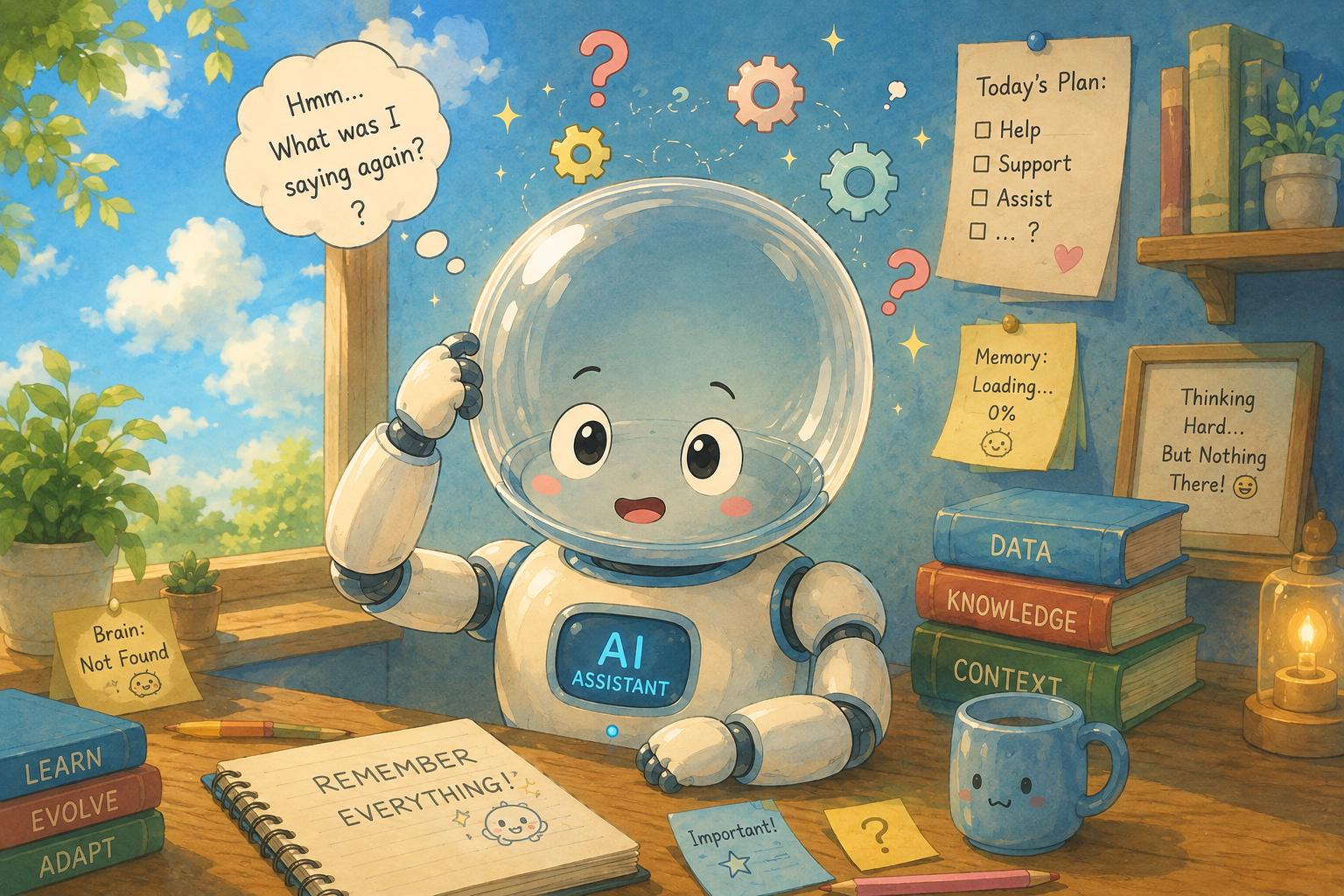
Every morning, millions of people open their AI assistant and do the same thing.
They explain themselves. Again.
Who they are. What they're working on. What was decided last week. What their preferences are. What "don't do this" means, for the fifth time.
It's like showing up to work every day with a brand new colleague — one who's brilliant, fast, capable of anything... and has never met you before.
The Groundhog Day Loop
Here's the pattern, and you've probably lived it:
You spend 20 minutes giving an AI tool full context on a project. It gets it. You get real work done together.
Tomorrow? Gone. Blank slate. Start over.
Multiply that by every user, every day, every conversation. That's not a small tax — that's an entire layer of hidden work nobody talks about. We give it a shrug and call it "just how AI is." But it's not how AI has to be.
Why This Actually Matters
This isn't a minor UX gripe. It's the single biggest thing standing between AI tools and AI partners.
- For builders, it means AI that never really learns your codebase, your standards, your history.
- For doctors and clinicians, it means re-explaining patient context instead of the AI already knowing the thread.
- For anyone doing serious work, it means the smartest tool in the room keeps forgetting the room.
The intelligence is there. The memory isn't. And that gap is where all the frustration lives.
Let's Put a Number On It
Say your daily context — your project background, preferences, history — runs about 2,000 tokens. Now say you re-paste that same context in 5 conversations a day.
That's 10,000 tokens a day spent just re-explaining yourself — before the AI has done a single second of real work.
Over a month, that's roughly 300,000 tokens. Over a year, north of 3.5 million tokens — burned purely on repetition, not output.
Now multiply that across a team of 20 people doing this daily. The math stops being a rounding error and starts looking like a real line item — in tokens, in cost, and in time everyone loses just getting the AI back up to speed.
Memory doesn't just make AI feel smarter. It makes every single one of those tokens go toward actual work instead of re-introduction.
(Numbers above are illustrative, based on typical context sizes — actual usage varies by workflow.)
What We're Building Toward
We've been staring at this problem for a while now, and we think it's solvable — not with a bigger context window, not with "paste this in again," but with something that actually remembers, the way a good colleague does.
We're not ready to show you what we're building yet. But this month, we wanted to name the problem clearly, because once you see it, you can't unsee it: every "new conversation" shouldn't mean a new relationship.
Something's coming. Stay tuned.
— More soon.