From the Founder's Desk
Growth Doesn't Fail Overnight. It Slows Down Quietly.
As founders and business leaders, we spend a lot of time chasing growth.
We look for more leads, bigger deals, better marketing campaigns, improved customer retention, and higher operational efficiency. We invest in new technologies, hire great people, and constantly refine our strategies.
Yet, despite all these efforts, growth often feels... harder than it should.
Over the last year, I've had the opportunity to meet founders, CXOs, hospital administrators, and business leaders across healthcare, education, government, and technology. Interestingly, every conversation began with a different challenge.
"We need more leads."
"Our sales team isn't converting enough."
"Customers don't come back."
"Operations have become too complex."
"We're exploring AI, but don't know where to start."
At first, these appeared to be completely different problems.
But the more conversations we had, the more a fascinating pattern emerged.
Most organizations weren't struggling because of dozens of disconnected issues.
They were struggling because of one or two invisible bottlenecks that quietly affected everything else.
A weak customer onboarding process led to poor retention.
Poor follow-up resulted in declining conversions.
Disconnected systems slowed down teams.
Lack of visibility delayed important decisions.
In many cases, leaders were solving symptoms while the real problem remained hidden beneath the surface.
That realization stayed with me.
The Question That Started It All
Every client engagement at ROVA AI begins with understanding the business before recommending technology.
We spend time asking questions.
How do customers discover your business?
What happens after the first enquiry?
Where do opportunities get lost?
How does your team make decisions?
What does your customer journey actually look like?
The answers often reveal insights that dashboards never do.
One day, our team asked ourselves a simple question.
What if every business leader could gain this level of clarity without weeks of workshops or expensive consulting engagements?
What if AI could help leaders pause, reflect, and identify the biggest opportunities for growth in just a few minutes?
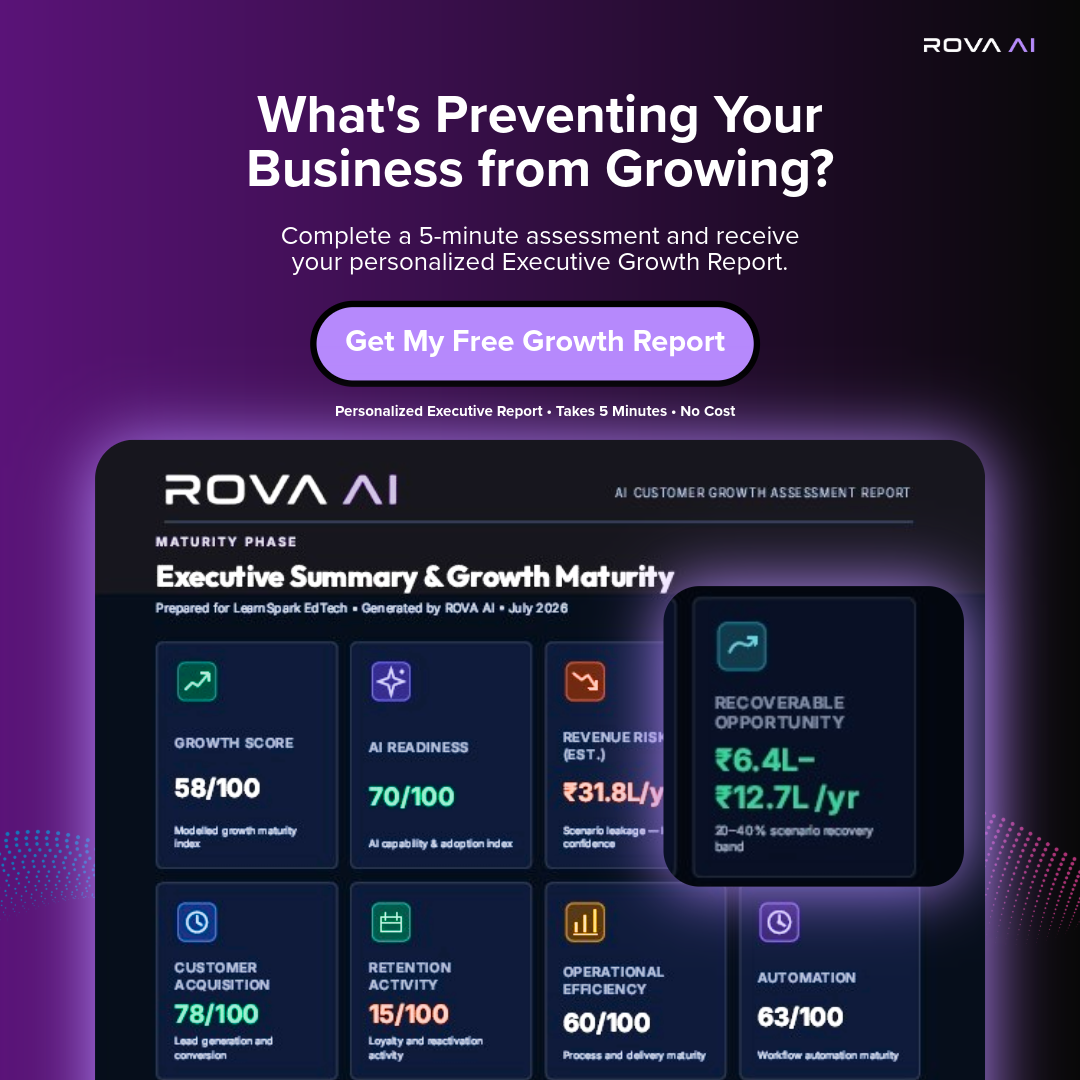
That question became the inspiration behind our newest initiative—the Executive Growth Report.
More Than a Report
The Executive Growth Report isn't designed to tell you whether your business is "good" or "bad."
Business is rarely that simple.
Instead, it provides a structured way to evaluate the areas that matter most to sustainable growth.
It examines how effectively an organization acquires customers, delivers exceptional experiences, operates efficiently, leverages technology, adopts AI, empowers its teams, and prepares for future growth.
More importantly, it highlights where small improvements can create disproportionately large outcomes.
Sometimes increasing growth isn't about working harder.
It's about removing the right constraint.
AI Should Help Leaders Think Better
There's a lot of conversation today about using AI to automate work.
And rightly so.
AI is transforming how organizations communicate, serve customers, and improve productivity.
But I believe one of AI's greatest opportunities lies elsewhere.
It can help leaders think more clearly.
It can connect patterns humans may overlook.
It can surface opportunities hidden within everyday business operations.
It can provide objective perspectives that are often difficult to see when you're immersed in running the business every day.
Technology shouldn't replace strategic thinking.
It should enhance it.
That's exactly how we designed the Executive Growth Report.
Not as another dashboard.
Not as another analytics tool.
But as a conversation starter.
Every Great Transformation Starts with Awareness
One lesson I've learned throughout my entrepreneurial journey is this:
Businesses rarely fail because they stop working hard.
They struggle because they continue solving yesterday's problems while tomorrow's challenges quietly emerge.
Growth requires occasional moments of reflection.
It requires stepping back from day-to-day operations and asking difficult questions.
Are we solving the right problems?
Are we creating the experience our customers truly expect?
Is our team spending time on meaningful work—or repetitive tasks that AI could handle?
Are we building a business that's ready for the next five years, not just the next quarter?
The answers to these questions often determine whether a business merely survives—or truly scales.
Looking Ahead
The Executive Growth Report is our contribution to helping leaders begin that journey.
Not with assumptions.
Not with guesswork.
But with clarity.
Whether you're leading a startup, a growing enterprise, a healthcare organization, or a public institution, meaningful growth starts with understanding where you stand today.
Because transformation doesn't begin with technology.
It begins with awareness.
And awareness leads to better decisions.
As always, I would love to hear your thoughts, your feedback, and the challenges you're navigating in your own growth journey. Together, let's build organizations that don't just grow faster—but grow smarter.
Warm Regards,