Everyone Wants AI. But Is Your Business Actually Ready for It?
Artificial Intelligence has become the boardroom's favourite topic.
Every week, a new AI tool promises to automate operations, improve customer experience, reduce costs, or increase revenue. Companies are investing millions in AI, hoping to gain a competitive edge.
Yet many AI initiatives fail to deliver meaningful business value-not because the technology doesn't work, but because organisations begin with the wrong question.
Most CEOs ask:
Which AI tool should we buy?
The better question is:
Is our business ready to get value from AI?
AI is not just another software purchase. It's a business transformation initiative. And like any transformation, success depends far more on preparation than implementation.
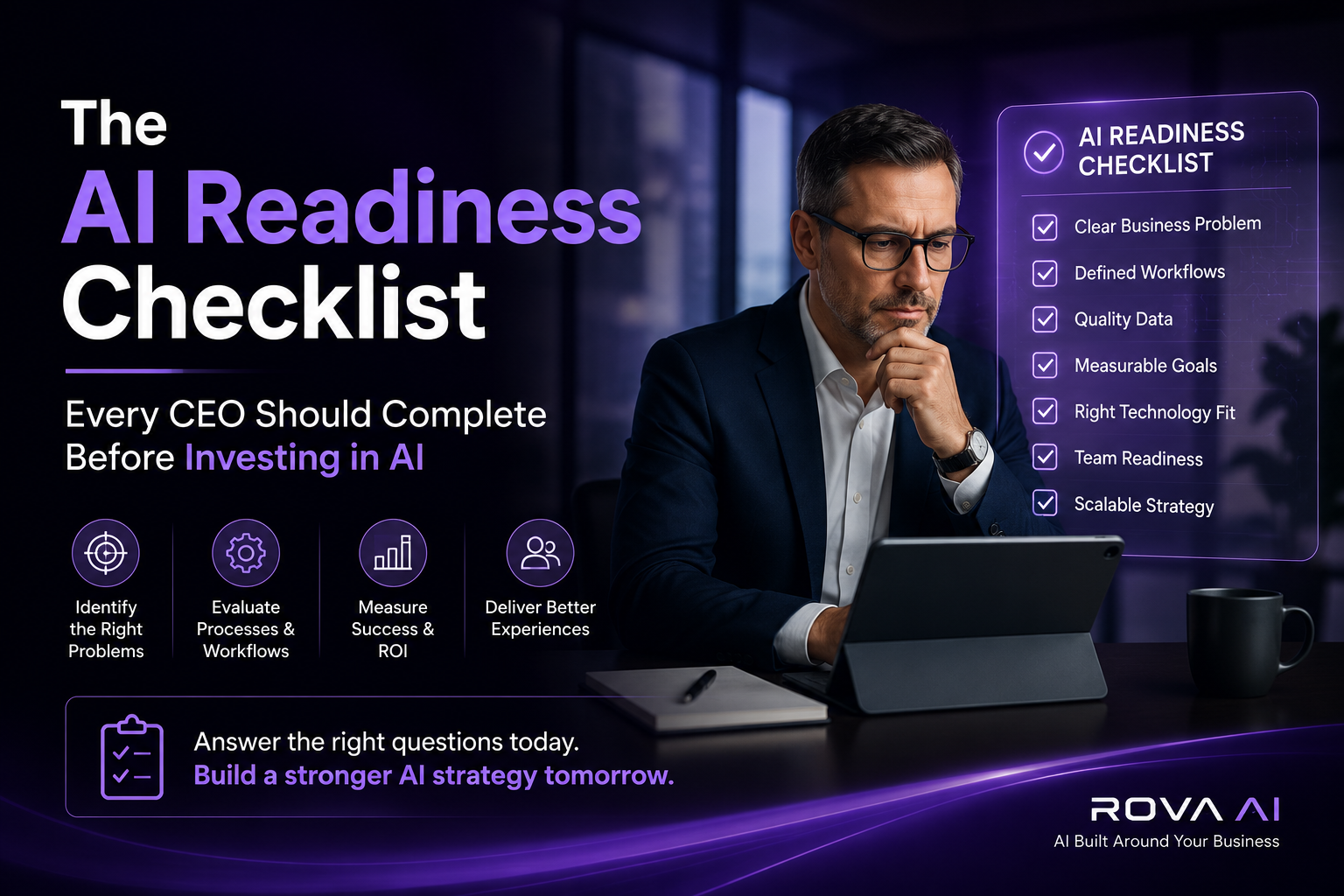
Before investing in AI, every CEO should complete this readiness checklist.
1. Have You Identified the Right Business Problem?
AI should never be implemented simply because it's trending.
Instead of asking:
How do we use AI?
Ask:
Which business problem costs us the most every month?
Examples include:
- Missed customer enquiries
- Slow response times
- Manual administrative work
- Poor lead conversion
- High operational costs
- Inefficient customer support
- Appointment scheduling bottlenecks
- Low employee productivity
The clearer the problem, the more valuable the AI solution.
2. Are Your Processes Clearly Defined?
AI amplifies existing processes.
If your workflow is inconsistent, AI will simply automate inconsistency.
Before adopting AI, ask:
- Are our customer journeys documented?
- Do teams follow standard operating procedures?
- Can we identify repetitive tasks?
- Are responsibilities clearly assigned?
Businesses with structured processes see faster AI adoption and better outcomes.
3. Is Your Team Spending Too Much Time on Repetitive Work?
One of the easiest ways to identify AI opportunities is by observing where employees spend their time.
Ask yourself:
- How many hours are spent answering repetitive questions?
- How much time is spent manually scheduling appointments?
- How many follow-up calls happen every day?
- Which tasks don't require human creativity or judgment?
These repetitive activities are often the first candidates for intelligent automation.
4. Do You Know What Success Looks Like?
One of the biggest reasons AI initiatives disappoint is the absence of measurable goals.
Before implementation, define success clearly.
Examples include:
- Reduce response times
- Increase customer satisfaction
- Improve lead conversion
- Reduce missed opportunities
- Lower operational costs
- Improve employee productivity
Without measurable outcomes, it's impossible to evaluate AI's impact.
5. Is Your Customer Experience Consistent?
Customers expect businesses to be responsive, available, and reliable.
Ask yourself:
- Can customers reach us after business hours?
- Are enquiries answered quickly?
- Is every customer receiving the same quality of service?
- Are follow-ups happening consistently?
Every missed interaction is a missed opportunity.
AI can help create consistency but only when customer experience is treated as a strategic priority.
6. Are You Solving the Right Problems First?
Many organisations try to automate everything at once.
The most successful AI projects begin with one high-impact process.
Instead of transforming the entire organisation overnight, identify one workflow where AI can create measurable value quickly.
Small wins build confidence, encourage adoption, and create momentum for larger transformation.
7. Does Your AI Fit Your Business-or Are You Changing Your Business to Fit AI?
This may be the most important question of all.
Many AI solutions are built as one-size-fits-all products.
Businesses are expected to adapt their workflows around the software.
The better approach is the opposite.
AI should understand your business, your customers, your processes, and your goals—not force you into predefined templates.
Every business is different.
Its AI should be too.
Your AI Readiness Checklist
Before investing in AI, ask yourself:
✅ Have we identified a clear business problem?
✅ Are our workflows documented?
✅ Do we know which repetitive tasks consume the most time?
✅ Have we defined measurable business outcomes?
✅ Is our customer experience consistent?
✅ Are we starting with the highest-impact opportunity?
✅ Does our AI adapt to our business-not the other way around?
If you answered "No" to even one of these questions, your organisation may benefit from assessing its AI readiness before choosing a solution.
AI Doesn't Create Transformation. Preparation Does.
The companies seeing the greatest returns from AI aren't necessarily using the most advanced technology.
They're the ones that understand where AI can create the greatest business impact.
AI is not about replacing people.
It's about helping your people focus on the work that matters most while technology handles the repetitive, time-consuming tasks.
The result isn't just greater efficiency- it's better customer experiences, stronger teams, and smarter business decisions.
Ready to Discover Where AI Can Create the Biggest Impact?
Before investing in AI, understand your organisation's readiness.
Take our AI Growth Assessment to identify opportunities, uncover operational bottlenecks, and receive a personalised roadmap showing where AI can deliver the highest return for your business.
👉 Start Your AI Growth Assessment Today
https://www.getrova.ai/growth-assessment